
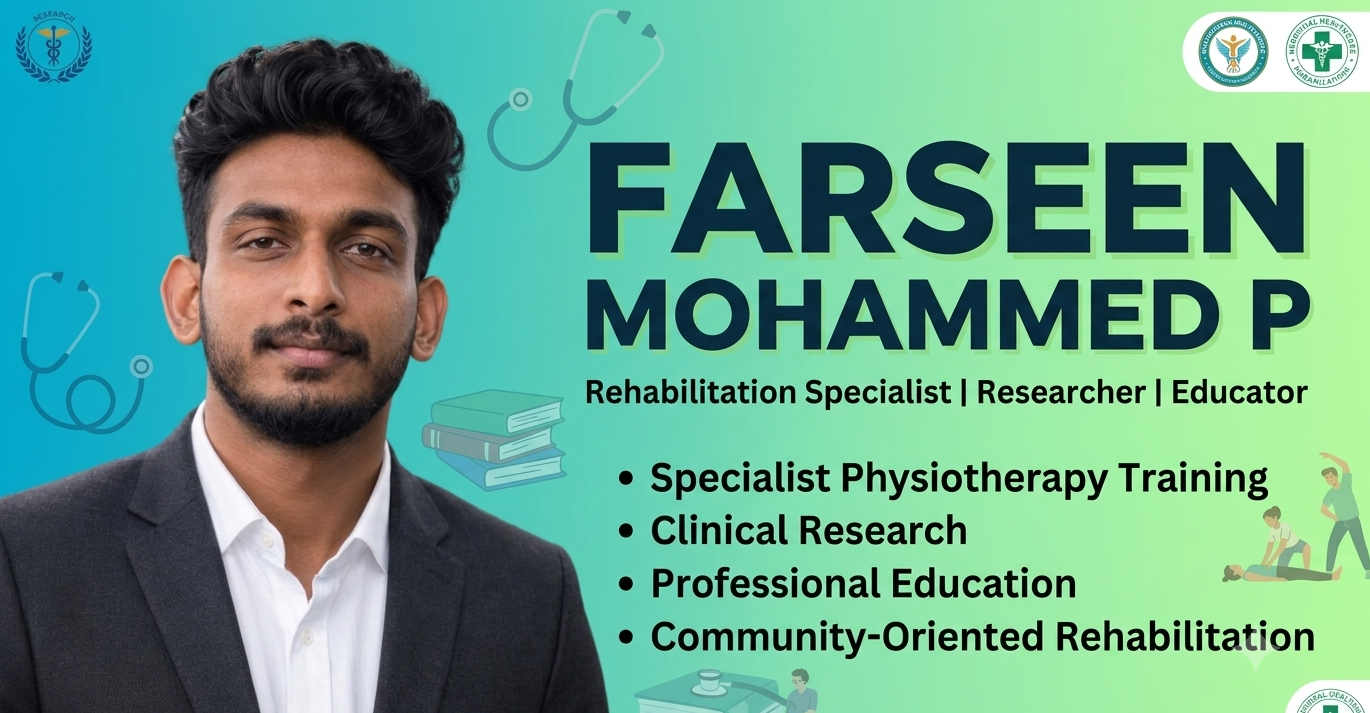


Mangaluru, Karnataka: Modern physiotherapy is increasingly connected with clinical research, evidence-based decision-making and innovation in healthcare. For Farseen Mohammed P, a specialist physiotherapist in neurosciences and clinical researcher, these areas have become important parts of his professional development.
With postgraduate specialization in neurosciences, clinical experience in neurological rehabilitation and an expanding research portfolio, Farseen is developing a professional profile that brings together physiotherapy practice, scientific inquiry and academic engagement.
A Foundation in Physiotherapy
Farseen’s professional journey began with a Bachelor of Physiotherapy (BPT) from the Co-operative Institute of Health Sciences, Thalassery, affiliated with Kerala University of Health Sciences.
His undergraduate education provided exposure to clinical physiotherapy and rehabilitation, while his undergraduate research project on the prevalence of plantar fasciitis in women introduced him to structured academic investigation.
He later pursued postgraduate education in a more specialized area of physiotherapy.
Specialization in Neurosciences
Farseen completed his Master of Physiotherapy in Neurosciences at Yenepoya Physiotherapy College, Yenepoya (Deemed to be University), Mangaluru.
His postgraduate specialization focused on neurophysiotherapy and neurorehabilitation.
This specialization has shaped his professional interests around neurological conditions, functional recovery, therapeutic exercise and rehabilitation strategies.
His clinical exposure during postgraduate training at Yenepoya Medical College Hospital included patients with stroke, Parkinson’s disease, traumatic brain injury, Guillain–Barré syndrome and spinal cord disorders.
Connecting Clinical Practice With Research
A significant feature of Farseen’s professional development has been his effort to connect clinical physiotherapy with research.
His postgraduate dissertation examined:
“Effect of Eccentric Versus Concentric Strengthening on Functional Mobility in Subacute Stroke Patients: A Randomized Parallel-Group Comparative Study.”
The study investigated strengthening approaches in the context of stroke rehabilitation and functional mobility.
This research experience contributed to his continued interest in therapeutic exercise and evidence-based rehabilitation.
Research as a Tool for Better Rehabilitation
For rehabilitation professionals, research can provide a framework for evaluating interventions and understanding which approaches may be useful for particular patient populations.
Farseen’s research interests reflect this perspective.
His portfolio includes systematic reviews, scoping reviews and clinical intervention research involving neurological rehabilitation and other areas of healthcare.
His work has explored topics including stroke recovery, Parkinson’s disease, therapeutic exercise, cardiac rehabilitation and metabolic health.
Contribution to Parkinson’s Disease Research
Farseen has also contributed to published research in Parkinson’s disease.
He is the second author and corresponding author of the 2026 scoping review:
“Timing of Dopaminergic Medication Relative to Physiotherapy Delivery in Adults with Parkinson’s Disease: A Scoping Review.”
The research examines the available evidence concerning the relationship between medication timing and physiotherapy delivery in adults with Parkinson’s disease.
The publication represents an important step in his development as a clinical researcher working within neurological rehabilitation.
Innovation and Evidence-Based Practice
Innovation in physiotherapy does not necessarily mean introducing entirely new technology. It can also involve improving how existing knowledge, clinical methods and research evidence are applied to patient care.
Farseen’s professional interests in evidence synthesis, therapeutic exercise and rehabilitation research demonstrate this broader understanding of innovation.
His work includes systematic and scoping reviews designed to organize and evaluate existing evidence.
Training in Systematic Review and Meta-Analysis
To strengthen his research capabilities, Farseen participated in a five-day hands-on international-level workshop on Systematic Review and Meta-Analysis conducted by IIRA, Mumbai, from 27 to 31 August 2026.
Research-methodology training can support healthcare professionals in developing structured approaches to literature evaluation, evidence synthesis and research interpretation.
For a clinician interested in evidence-based physiotherapy, these skills can complement practical clinical experience.
Participation in Academic Innovation Activities
Farseen’s interest in innovation also extends to institutional academic activities.
In July 2026, he participated as a member of the Organising Committee for an Institution’s Innovation Council awareness workshop at Yenepoya Physiotherapy College.
The programme focused on “Entrepreneurship & Innovation as a Career Opportunity.”
His involvement provided exposure to discussions connecting healthcare education with innovation and entrepreneurship.
Scientific Communication and Research Presentation
Innovation and research also require effective communication.
Farseen has presented his work at professional physiotherapy conferences, including Mangalore PhysioCon 2026 and SYNERGOS 2026.
At Mangalore PhysioCon, he presented his postgraduate research on strengthening interventions and functional mobility in subacute stroke patients.
At SYNERGOS 2026, he presented a systematic review on eccentric strengthening interventions in stroke rehabilitation and received the First Prize in the Postgraduate Category for Oral Paper Presentation.
These experiences have strengthened his role as both a researcher and scientific communicator.
Clinical Rehabilitation Skills
Alongside research, Farseen continues to build his clinical foundation.
His neurological rehabilitation training has included approaches such as:
- Neurodevelopmental Treatment
- Motor Relearning Programme
- Task-oriented training
- Therapeutic exercise
- Functional rehabilitation
His clinical exposure includes neurological and rehabilitation conditions requiring individualized approaches to movement, mobility and functional recovery.
A Broader Rehabilitation Perspective
Farseen’s professional interests extend beyond a single neurological diagnosis.
His research portfolio includes work related to exercise-based cardiac rehabilitation and metabolic health.
He has also completed a Postgraduate Diploma in Nutrition, adding another dimension to his understanding of health and rehabilitation.
This broader academic background supports an interdisciplinary perspective in which exercise, rehabilitation, nutrition and clinical evidence can be considered as interconnected areas.
Sharing Knowledge With Healthcare Professionals
Another aspect of Farseen’s professional development is knowledge sharing.
On 5 September 2026, he served as a resource person for a CME programme for nursing professionals at St. Joseph’s Mission Hospital, Anchal, Kerala.
His session, “Life After Discharge: Physiotherapy-Guided Secondary Prevention and Community Reintegration,” focused on rehabilitation after hospital discharge.
Such professional education activities allow clinical and research knowledge to be communicated to other healthcare professionals.
Building a Future-Oriented Professional Profile
Farseen Mohammed P’s professional development reflects three interconnected areas:
Physiotherapy provides the clinical foundation.
Research provides a framework for investigating rehabilitation questions and evaluating evidence.
Innovation creates opportunities to improve how knowledge and rehabilitation approaches are developed and communicated.
His academic qualifications, clinical experience, research publications and professional activities demonstrate movement across all three areas.
Looking Ahead
As healthcare continues to place greater emphasis on evidence-based practice, multidisciplinary care and measurable rehabilitation outcomes, physiotherapists with clinical and research skills can contribute to the development of modern rehabilitation services.
Farseen’s continuing work in neurophysiotherapy, therapeutic exercise, evidence synthesis and clinical research places him within this evolving professional landscape.
His ongoing systematic and scoping reviews, combined with clinical and academic engagement, provide a foundation for further development in neuroscience rehabilitation and research.
Farseen Mohammed P’s journey therefore represents more than a traditional clinical pathway. It reflects an emerging model of physiotherapy professional development in which clinical expertise, scientific research and innovation work together to support the future of rehabilitation.